
How SecurTRAK Is Different – Why Hospitals and Government Facilities Choose Us
Not all real-time locating systems are created equal. Most RTLS solutions rely on Wi-Fi or Bluetooth Low Energy (BLE) — technologies designed for data communication, not precision location tracking. SecurTRAK uses a dedicated, hardwired active RFID and RF triangulation infrastructure that delivers unmatched accuracy, reliability, and coverage that wireless-dependent systems simply cannot match.

Three Pillars That Set SecurTRAK Apart
1. Unmatched Accuracy
SecurTRAK delivers unmatched accuracy by combining three complementary wireless technologies on a single hardwired infrastructure — something no Wi-Fi or BLE system can match:
- Active RFID at 433 MHz provides blanket coverage indoors and outdoors across the entire campus, with 5-meter accuracy — precise enough to identify which specific room a tag is in. Its critical advantage: the 433 MHz signal cannot be covered up or blocked by blankets, bedding, clothing, body mass, walls, or equipment. Tags are never lost to the system, making this the always-on reliability backstop that keeps SecurTRAK dependable when lives are on the line
- Diffused Infrared (IR) locates tags to a specific bed in a multi-bed room, or to room-specific accuracy, because IR does not penetrate walls. This delivers pinpoint precision where it matters most — ICU beds, isolation rooms, procedure rooms, and any location where knowing the exact bed or room is clinically critical. IR can be momentarily blocked if a tag is covered (under a patient blanket, for example) — but the 433 MHz layer continues tracking without interruption, so tags are never lost to the system
- Low-Frequency (LF) Exciters create a field-adjustable electromagnetic bubble with a 2-to-12-foot radius, tuned precisely to the choke point you need to protect. LF exciters trigger instant, precise alerts at doorways, elevators, stairwells, loading docks, and geo-fence boundaries — eliminating false alerts and enabling millisecond boundary detection
No single technology can deliver bed-level precision, bulletproof reliability, and precise boundary control at the same time. SecurTRAK’s three-layer approach ensures that if IR is momentarily obstructed, the 433 MHz blanket layer maintains continuous tracking — delivering the accuracy, reliability, and flexibility that life-safety applications demand, all on a single infrastructure investment. Outdoors, the 433 MHz blanket coverage bridges indoor precision to campus-wide visibility with line-of-sight/quadrant accuracy and no Wi-Fi or BLE dead zones.
2. Proven Dependability
- 99.8% uptime since 2002 at VA medical centers — over two decades of continuous operation
- Hardwired infrastructure — no power outage worries; impervious to compromised servers, Wi-Fi/Bluetooth jamming, or cyber attacks
- No Wi-Fi or BLE dead zones — complete campus coverage indoors AND outdoors
- Tamper notifications on all tags and devices
- Seamless integration with hospital IT systems while maintaining data integrity
3. Total Customization
- Customized to unique and aging infrastructure — every facility is different, and we engineer solutions that fit yours
- Individualized geo-fences with business rules for each patient, staff member, or asset
- Aligned to patient and personnel privacy rights and regulations
- APIs integrate accurate location data with your existing systems (EMR, asset management, security)
- Displayed on AutoCAD floor and site plans in a standard web browser showing real-time locations
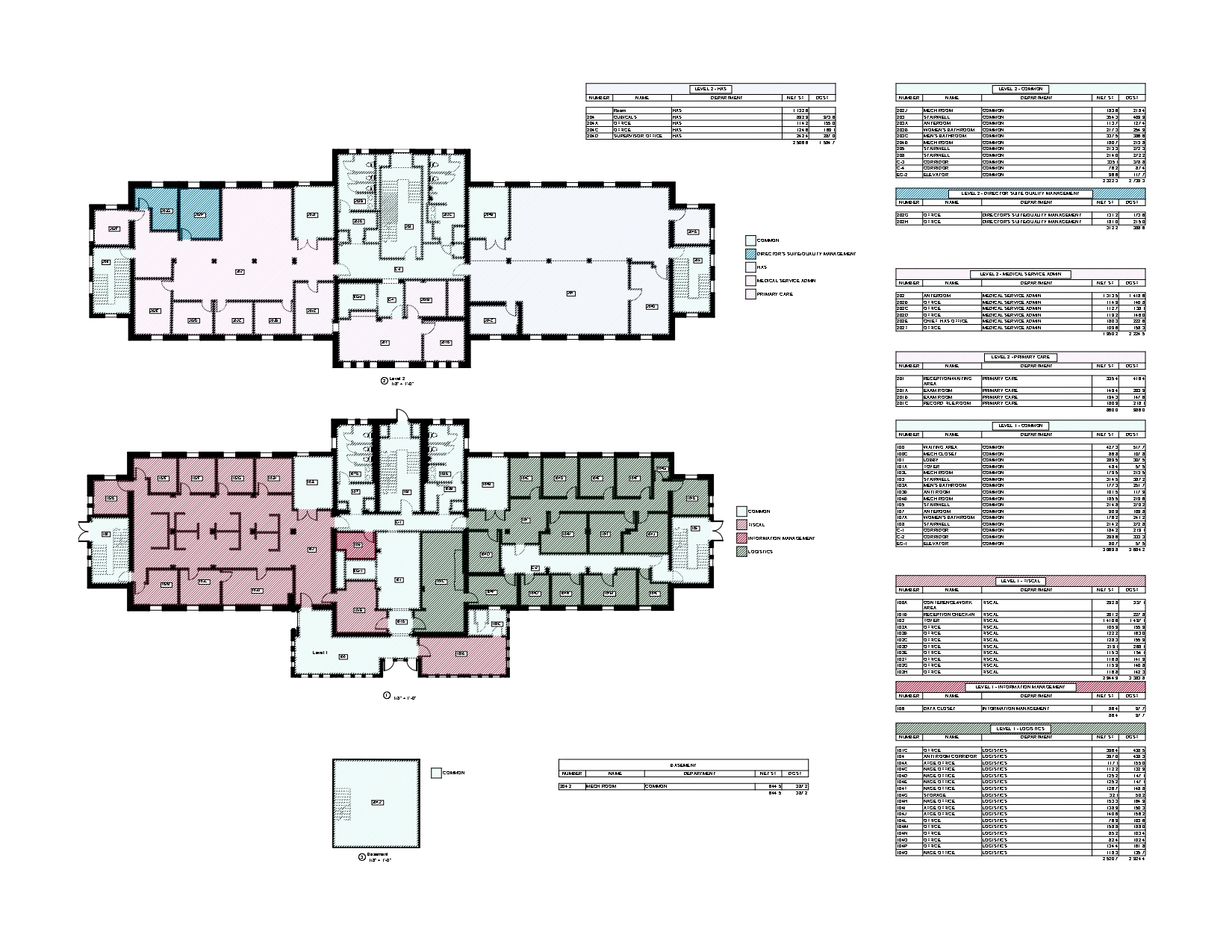
- 3D Lidar Campus Scanning & Capital Asset Inventory: We scan your complete campus with a 3D color camera with lidar to accurately capture the existing footprint of all spaces. We associate space owners with every space on campus floor plans, colorize by ownership, and calculate the square footage each space owner occupies — ready for insertion into your Capital Asset Inventory (CAI) database for budgetary space management
See SecurTRAK in Action
TV Interview: Why 433 MHz RF Beats Wi-Fi & BLE for Life-Safety RTLS
SecurTRAK vs. Wi-Fi and Bluetooth/BLE RTLS
| Feature | SecurTRAK (Active RFID) | Wi-Fi / BLE RTLS |
|---|---|---|
| Accuracy | 5 meters indoors | 10-15 meters (sometimes) |
| Outdoor Accuracy | Line-of-sight / Quadrant | Limited/none |
| Infrastructure | Hardwired (hack-proof) | Wireless (vulnerable) |
| Uptime | 99.8% | Variable |
| Power Outage | Unaffected | System down |
| Wall Penetration | Excellent (433 MHz) | Poor (2.4 GHz) |
| BLE/Bluetooth Dead Zones | None | Common |
| CCTV/Door Integration | Built-in (proactive) | Add-on |
Why Wi-Fi and Bluetooth/BLE Signals Degrade in Hospitals
Wi-Fi operates at 2.4 GHz — a frequency that struggles to penetrate concrete walls, steel-reinforced structures, and lead-lined rooms found in hospitals. Bluetooth Low Energy (BLE) is even worse: it uses the same 2.4 GHz frequency but at significantly lower power levels, making BLE tags even more difficult at penetrating hospital walls and dense building materials. SecurTRAK’s 433 MHz active RFID frequency was specifically chosen for its superior wall penetration characteristics.
Read more: Why 2.4 GHz Will Never Work for Life-Safety RTLS
One Infrastructure, Three Life-Safety Applications
SecurTRAK’s hardwired infrastructure supports PatienTRAK (elopement prevention & patient tracking), PanicALERT (staff duress & wireless panic), and AsseTRAK (real-time asset tracking) — all on a single investment. Start with one application and add others with a simple software upgrade.

M.G.M. Computer System, Inc. (dba MGM Solutions)
SAM UEI#: MJWBAKSGRK81 • CAGE Code: 1S3X7
Deployed within the VA since 2002 • 99.8% Uptime
VA TRM and ERA Certified • Staff holds highest level of VA BI clearance
What Our Clients Value Most
- Hardwired system avoids failure from hacking, Wi-Fi/BLE interference, or loss of power
- Initial installation supports add-on supplemental protections without new infrastructure
- Funds saved through efficiencies in operations and equipment tracking
- Facility stands continuously ready for JCAHO inspections
- Easy-to-use system promotes early adoption by staff
Ready to Protect Your People and Assets?
Contact our team for a free consultation and facility assessment.
Call: sales@mgm-solutions.com •
Email: sales@mgm-solutions.com
© 2026 M.G.M. Computer System, Inc. (dba MGM Solutions). All rights reserved.
Frequently Asked Questions
What makes SecurTRAK different from other RTLS?
SecurTRAK combines three technologies in every tag: 433 MHz active RFID for building-wide coverage, infrared for room and bed identification, and low-frequency exciters for floor determination and door control. This triple-technology approach delivers accuracy and reliability that single-technology systems cannot match.
Why does MGM use 433 MHz instead of Wi-Fi or BLE?
433 MHz has approximately 15 dB less path loss than 2.4 GHz (Wi-Fi/BLE), penetrating concrete, steel, and masonry significantly better. It operates on a dedicated frequency, not sharing bandwidth with hospital IT. NIST data shows 31 dB loss through 8 inches of reinforced concrete at 2.4 GHz — effectively killing BLE signals.
Does SecurTRAK depend on hospital IT infrastructure?
No. SecurTRAK operates on a completely standalone dedicated network with its own fiber, servers, and receivers. Alerts fire during network outages, cybersecurity lockdowns, and internet failures — because a life-safety system must never depend on shared infrastructure.
One Infrastructure, Whole Campus: Indoors + Outdoors
Here is the differentiator no other elopement prevention or staff duress vendor matches: SecurTRAK delivers every life-safety use case — elopement prevention, staff duress, infant security, asset tracking — indoors AND outdoors on a single infrastructure. Door-based wander systems end at the door. Wi-Fi and BLE systems end where indoor coverage ends. SecurTRAK’s 433 MHz active RFID backbone covers patient rooms, corridors, courtyards, parking lots, and campus grounds with the same tags, the same map, and the same alerting pipeline. One system to buy, one system to learn, one system to trust — proven on VA medical center campuses since 2002.
Between the Exits: The Gap Door-Only Systems Cannot See
Many of the worst elopement outcomes, and the large settlements that follow, share one detail: the patient was gone long before anyone knew. A door-only system hears a tag only when it reaches a covered exit. Between those exits, it hears nothing. If a band is cut in the day room or a battery dies in a hallway, a door-only system has no way of knowing until the patient reaches a door, and sometimes not even then.
SecurTRAK supervises every tag continuously, everywhere the system covers, indoors and out:
- Every tag checks in, all the time. Tags transmit their ID every 10 seconds while moving and every 60 seconds while stationary.
- A silent tag is an alert, not a mystery. If a tag misses its expected check-in, staff get a “lost” alert with the patient’s last known location.
- Tamper and removal alerts are instant. The moment a patient tampers with a tag or tries to remove it, staff are notified, wherever it happens.
- Low battery is reported before it fails. The tag sends a replacement alert while it is still working, so a dead tag is never discovered at the door.
- Tags are reusable. Batteries are field-replaceable in a couple of minutes. Some systems use tags that must be replaced outright every two to three years, a recurring cost that grows with every tag in use.
An instant alert beats a bed check. Bed checks are only as reliable as the people doing them, and on a busy unit some checks run late or never happen. A bed check confirms a patient is already missing. A SecurTRAK alert tells staff to go find the patient while there is still time.
Go deeper: tag battery and tamper supervision · full-floor RTLS vs. door-only monitoring · why alert latency matters
See the gap on your own floor plan. Ask for a free coverage review, email sales@mgm-solutions.com or call sales@mgm-solutions.com.
Talk to an RTLS Expert
MGM Solutions has deployed campus-wide life-safety RTLS in VA medical centers, hospitals, and corrections facilities since 2002 — elopement prevention, staff duress, infant security, and asset tracking, indoors AND outdoors on one infrastructure. When you call, you talk to the people who design, build, and install SecurTRAK.
Email sales@mgm-solutions.com | Request a live demo | sales@mgm-solutions.com