
PatienTRAK – Real-Time Patient Tracking & Elopement Prevention System
PatienTRAK by SecurTRAK is the most dependable real-time patient tracking and elopement prevention system available for hospitals, VA medical centers, behavioral health facilities, and memory care units. Using active RFID and RF triangulation technology, PatienTRAK provides 24/7 wander management that locates at-risk patients anywhere on your campus — indoors and outdoors — with 5-meter accuracy indoors and line-of-sight/quadrant accuracy outdoors.
Indoors AND Outdoors — One System, No Blind Spots
Most elopement systems stop protecting patients at the door. PatienTRAK is different: the same tag that shows a patient at their bed shows them in the courtyard, the parking lot, or anywhere on campus grounds — continuous real-time location indoors and outdoors on a single infrastructure, with one map and one alerting workflow. No bolt-on outdoor add-ons, no second console, no seam where protection fails. Learn why campus-wide coverage is the new standard of care.

The Critical Problem: Patient Elopement & Wandering
At-risk patients with Alzheimer’s, dementia, traumatic brain injury, or psychiatric conditions may elope from safe areas without warning. Traditional WanderGuard-style systems only alert at exit doors — by then, the patient may already be in danger. PatienTRAK goes far beyond basic elopement detection by proactively tracking patient movement and alerting staff before a breach occurs.
How PatienTRAK Works
Each at-risk patient wears a lightweight, tamper-resistant active RFID tag. Our hardwired RTLS infrastructure continuously tracks tag location using RF triangulation, displaying real-time patient tracking data on AutoCAD floor plans in a standard web browser. Staff receive instant alerts via PC, smartphone, pager, email, or text when a patient approaches or crosses a geo-fenced boundary.
SecurTRAK combines three complementary technologies on a single hardwired infrastructure: Active RFID at 433 MHz provides blanket indoor/outdoor coverage with 5-meter (room-level) accuracy and cannot be covered up or blocked — the always-on reliability backstop that keeps tags from ever being lost to the system. Diffused Infrared (IR) locates tags to a specific bed in a multi-bed room or to room-specific accuracy (because IR does not penetrate walls), with the 433 MHz layer maintaining tracking if IR is momentarily blocked under a blanket or covering. Low-Frequency (LF) Exciters create a field-adjustable 2-to-12-foot electromagnetic bubble for instant choke-point detection at doorways, elevators, and boundaries. No Wi-Fi or BLE system can match this combination of blanket coverage, bed-level precision, and reliability.
Key Capabilities
- Elopement Prevention: Automatically locks elevators and exits when an at-risk patient approaches restricted zones — integration with access control and elevator control systems prevents patients from exiting floors or entering elevator cabs
- Wander Management: Individualized geo-fences with business rules for each patient; graduated alert sequencing notifies the right staff in the right order
- Infant Abduction Protection: Specialized infant abduction prevention mode with tamper-proof infant tags, mother-baby matching, and automatic lockdown protocols
- Proactive CCTV Integration: Automatic camera activation that follows a moving tag when in an alert condition, giving security real-time visual tracking
- Indoor + Outdoor Tracking: Seamlessly tracks patients from inside the facility to outdoor areas — no Wi-Fi or BLE dead zones. Bridges the gap between indoor-only RTLS and outdoor-only GPS
- Co-Location Alert: Triggers alerts when specific patients enter the same zone — critical for behavioral health and corrections settings
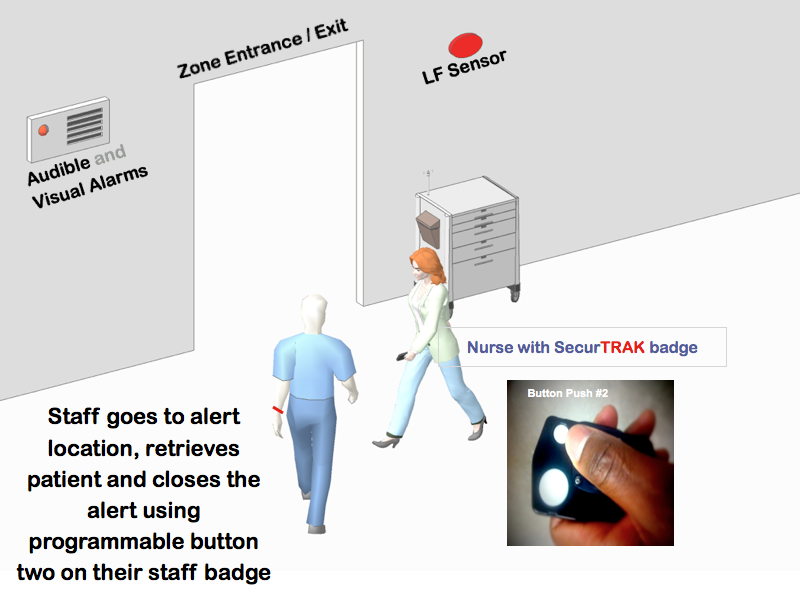
- Staff Badge Acknowledgment: Staff can clear alert events directly from their badge without returning to a monitoring station
Why PatienTRAK is the Best Elopement Prevention System
- 99.8% uptime since 2002 at VA medical centers — the most dependable real-time locating system in healthcare
- Hardwired infrastructure — impervious to hacking, Wi-Fi/Bluetooth interference, and power outages that disable wireless-only systems
- Largest VA RTLS installation: 7+ million square feet of coverage proving scalability across campus environments
- Patented technology: Including Intelligent Boundary Recognition and AutoCAD floor/site plan integration
- Continuous breach notification sequencing escalates to law enforcement if a patient exits the facility
- Staff are NOT tied to a computer screen — mobile alerts keep caregivers on the floor providing patient care
PatienTRAK for Behavioral Health & Memory Care
Elopement prevention is a Joint Commission National Patient Safety Goal. PatienTRAK helps facilities maintain compliance while protecting their most vulnerable patients. Our wander management system is deployed in psychiatric units, dementia wards, Alzheimer’s units, and rehabilitation centers across VA and private hospitals nationwide.
Integration with SecurTRAK Platform
PatienTRAK operates on the same infrastructure as PanicALERT (staff duress) and AsseTRAK (asset tracking). Deploy one system and expand to additional capabilities with a simple software upgrade. View all patient, staff, and asset locations on a single SecurTRAK Software Platform with AutoCAD floor plans in your web browser.

M.G.M. Computer System, Inc. (dba MGM Solutions)
SAM UEI#: MJWBAKSGRK81 • CAGE Code: 1S3X7
Deployed within the VA since 2002 • 99.8% Uptime
VA TRM and ERA Certified • Staff holds highest level of VA BI clearance
See SecurTRAK in Action
PatienTRAK: Real-Time Elopement Prevention & Wander Management
PatienTRAK: Simultaneous At-Risk Patient Location & Elopement Alerts
Ready to Protect Your People and Assets?
Contact our team for a free consultation and facility assessment.
Call: sales@mgm-solutions.com •
Email: sales@mgm-solutions.com
© 2026 M.G.M. Computer System, Inc. (dba MGM Solutions). All rights reserved.
Frequently Asked Questions
How does PatienTRAK prevent patient elopement?
PatienTRAK uses wristband tags with 433 MHz RF, infrared, and LF technology to monitor at-risk patients continuously. The system updates location every 10 seconds in motion and every 60 seconds stationary. When a patient approaches an exit, LF exciters trigger mag-lock engagement and elevator controls in milliseconds, while alerts route to staff immediately.
What happens when a patient removes their wristband?
PatienTRAK wristbands include tamper detection. If the band is cut, stretched, or removed, the system generates an immediate alarm and can automatically lock exits. This ensures protection even if a patient attempts to defeat the system.
How is PatienTRAK different from WanderGuard?
WanderGuard is a door alarm that only detects a patient at the exit. PatienTRAK is a continuous location system that tracks patients everywhere in the facility. It alerts staff when a patient leaves their unit — not when they reach the exit — giving time to intervene before an elopement becomes an incident.
Related Articles
Comparing Elopement Prevention Systems?
See how PatienTRAK compares to the door-based systems on your shortlist: WanderGuard (Securitas Healthcare) · Code Alert (RF Technologies) · Accutech
See Campus-Wide Life-Safety RTLS Live
MGM Solutions has protected patients and staff in VA medical centers, hospitals, and corrections facilities since 2002. When you call, you talk to the people who design, build, and install SecurTRAK — not a call center.
Email sales@mgm-solutions.com | Request a live demo | sales@mgm-solutions.com
The gap is between the doors
A well-built door-only system covers every exit, stairwells and elevators included, and locks them. That part is not in dispute. What it cannot do is see the tag between those doors — and that is where an elopement actually begins.
The band came off an hour ago
A patient cuts or slips the bracelet in their room. With no reader between the doors, the tamper is never seen and staff still believe the patient is monitored.
The battery died in a corridor
The tag goes silent, and silence is indistinguishable from a compliant patient. The failure surfaces when the door does not lock — the worst moment to learn about it.
Where they are right now
An exit alarm says a threshold was crossed. It does not say where the patient went next, indoors or out onto the grounds, and the search starts from the door.
Where the tag is actually visible
Reader
Door-only systems lock doors too. The difference is whether the lock ever fires. Both architectures interface with access control and elevator control, and both lock. We do it with LF exciters at every exit, stairwell and elevator cab, with escort override on the staff tag and fire-safety supersession. But a lock only fires if the system can see the tag at that moment, and an exit-detection system’s first and only look at a patient happens at the threshold. If the band came off in the day room, or the battery died in a corridor an hour earlier, there is nothing to detect when the patient reaches the door — the hardware works exactly as designed and the door stays unlocked. Continuous coverage is what makes the lock dependable: every tag is accounted for every 10 seconds in motion, so a cut band or failing battery raises an alert where it happens, not at a door the patient may never reach.
The reason this gap exists is physics, not product choice. Systems built on 2.4 GHz Wi-Fi and Bluetooth cannot hold coverage through the reinforced concrete and metal framing of a hospital, so they retreat to the doorway. We wrote up the frequency comparison in detail here: why we don’t build on Wi-Fi, BLE or 900 MHz.
Between the Exits: The Gap Door-Only Systems Cannot See
Many of the worst elopement outcomes, and the large settlements that follow, share one detail: the patient was gone long before anyone knew. A door-only system hears a tag only when it reaches a covered exit. Between those exits, it hears nothing. If a band is cut in the day room or a battery dies in a hallway, a door-only system has no way of knowing until the patient reaches a door, and sometimes not even then.
SecurTRAK supervises every tag continuously, everywhere the system covers, indoors and out:
- Every tag checks in, all the time. Tags transmit their ID every 10 seconds while moving and every 60 seconds while stationary.
- A silent tag is an alert, not a mystery. If a tag misses its expected check-in, staff get a “lost” alert with the patient’s last known location.
- Tamper and removal alerts are instant. The moment a patient tampers with a tag or tries to remove it, staff are notified, wherever it happens.
- Low battery is reported before it fails. The tag sends a replacement alert while it is still working, so a dead tag is never discovered at the door.
- Tags are reusable. Batteries are field-replaceable in a couple of minutes. Some systems use tags that must be replaced outright every two to three years, a recurring cost that grows with every tag in use.
An instant alert beats a bed check. Bed checks are only as reliable as the people doing them, and on a busy unit some checks run late or never happen. A bed check confirms a patient is already missing. A SecurTRAK alert tells staff to go find the patient while there is still time.
Go deeper: tag battery and tamper supervision · full-floor RTLS vs. door-only monitoring · why alert latency matters
See the gap on your own floor plan. Ask for a free coverage review, email sales@mgm-solutions.com or call sales@mgm-solutions.com.